This month was a little slow. I struggled with my fatigue and I was ill for a couple of weeks. In some ways, this left me with more reading time, which was nice, but I was hardly able to do much else. I didn’t watch any films this month, including any for the film challenge, as I was too tired to focus on anything for a solid length of time. I was especially looking forward to The Fifth Element, so I’m disappointed not to have fit it in. Perhaps May will be different!
There were two notable trends this month – Ancient Greek literature and dystopian literature. It was almost whiplash to go between the two but I enjoyed both genres more than I can say. It’s been a while since I’ve read anything dystopian, yet my return to the genre was a welcome one. I really enjoyed myself on this front. As for Ancient Greece, I’m not one to engage with this particular time period or genre. Not for any particular reason; I just haven’t tried it yet. Even so, the texts I read convinced me otherwise and I’d certainly be interested in reading more in the future. I also ended up engaging with other Greek-related fiction, such as Signs Preceding the End of the World and Kaos (the tv show). This was completely unintentional but this month felt very Greek inspired, as a result.
What I’ve Been Reading
This month, I read twelve texts! I haven’t read that much since I was a teen; I still can’t fathom that I’ve read them all. However, I’m excited to share my thoughts on them!
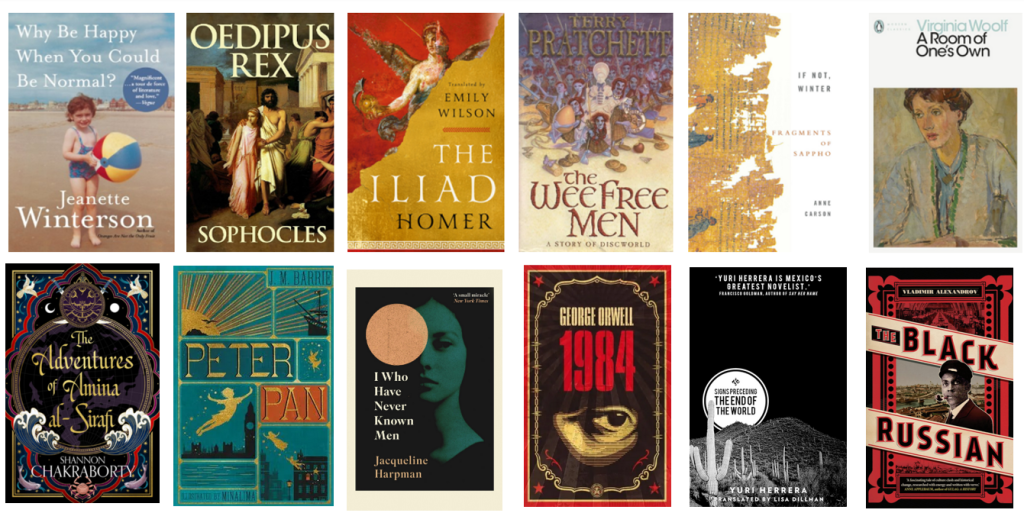
Why Be Happy When You Could Be Normal? by Jeanette Winterson
Winterson’s exploration of literature in childhood was deeply personal, not just to her but to my own personal experience. I understand the need for refuge in fiction, particularly when one is raised in an environment where your voice is hindered or moderated. Winterson does well at blurring the lines between reality and fiction – something she readily admits to – and I understand the impulse of finding fiction easier to live with than reality. Her candidness in sharing her search for her biological mother was inspiring. A refusal to neatly conclude her experience or to find answers for the sake of it is daring when so many wish to categorise our lives into neat little boxes. Winterson allows herself to be messy in both her real-life experience and in how she chooses to share that, and there is something deeply authentic about that. Altogether, this was a thought-provoking read.
Oedipus Rex by Sophocles
Oedipus Rex is a bleak tragedy about the ways in which we search blindly for truth and meaning. This is a genuine tragedy in the sense that nobody is inherently a bad person – not that I believe this to be true for real life either – but decisions were made, for better or worse, ones that rippled out into vast and terrible consequences. Jocasta was the most tragic of them all in my opinion and I struggled to even fathom how one would feel in those circumstances. Oedipus Rex was a quick but emotional read. At times, intense. I know this story through cultural osmosis but what we know of it doesn’t begin to cover the actual emotion of the play but, rather, caricatures it for the sake of pop psychology. In my opinion, the play deserves more than that. Oedipus Rex is much more complicated than pop culture credits it for. I enjoyed it immensely.
The Iliad by Homer
I was a little hesitant opening the Iliad but I was determined to try it. What I discovered was an epic filled with grief; the exploration of integrity; the responsibility and corruption of those in power; the vast loss, horror, and trauma of war and displacement; and our inability, at times, to accept the fate allotted to us. It was also filled with friendship, love, and moments of mischief and humour. The Iliad, in many ways, has everything. For its moderate length – though long for a poem – it contains so many aspects of human existence. I enjoyed this more than I ever thought I would; it encapsulated so much more than people said it would. This was a wonderful story, though it did lag at times, due to the vast descriptions of names, whether that be the soldiers, horses, or ships. I thoroughly enjoyed the journey I went on; this month has encouraged me to seek out literature from Ancient Greece more often. I’d love to read anything related to this story.
The Wee Free Men by Terry Pratchett (reread)
This was a notable childhood favourite. To the point where I was asked to read something else because I kept bringing it to school. To return to it as an adult was exciting. There were parts of it that were a little anti-climactic, mainly the Queen of Fairyland, but the exploration of the importance of dreams alongside reality, the humour around witchy stereotypes, and the roles of singular women in small communities was what made this story engaging. Naturally, the Wee Free Men are funny and I believe Pratchett did a good job of translating his humour into children’s literature. I don’t think this book is as compelling as his adult writing but I liked it well enough. It’s a children’s book and I loved it as a child, so I read it at the right time in my life. As an adult, I would no longer consider it to be a favourite but the Wee Free Men will always have a special place in my heart.
If Not Winter: Fragments of Sappho, Trans. Anne Carson
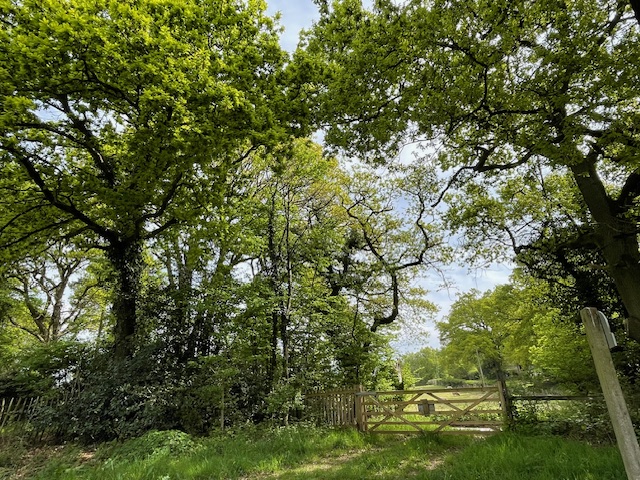
I read this on a spring morning, sitting next to the window where I could look out onto the sun-dappled trees. This was the perfect way to delve into these fragments. I’ve read some of Sappho’s more complete excerpts before but I was yet to read a full compilation. Easily, this cemented Sappho as one of my favourite poets of all time, even with the miniscule amount of writing we have left. I could read this book over and over again, and I believe I shall. I love this collection as much as I love Rumi’s. The fragments touching upon the Gods, her desire, the love for her brother, and the golden chickpeas growing along the bank perfectly exhibits her versatility as a poet and the depth of writing that once existed. I could not recommend this enough. I think it might have changed me. I think it still could.
A Room of One’s Own by Virginia Woolf
I’ve read a few of Woolf’s novels but it is this text that made me fall in love with her. Her essay reveals someone intelligent, discerning, and downright funny, whilst also being someone who is so effortlessly relatable. She is as intimidating in her intellect as she is unassuming towards herself. Woolf’s exploration of the history of women’s literature – their social and financial situation, the distinct difference between a man’s muse and a woman’s authentic self-expression – is a thoughtful and exacting account of why women write the topics they do, the limitations they face, and how women’s literature has evolved with the times. Stumbling across the infamous quote of ‘Chloe likes Olivia’ was an adrenaline rush that I can’t even begin to describe. The way she writes a fictional account of how she reflected upon the topic was amusing and contemplative in equal measure, if not anything short of brilliant. I couldn’t even begin to recommend this enough. I want to enfold it in my heart and keep it there forever.
The Adventures of Amina al-Sirafi by Shannon Chakraborty
I contemplated abandoning this book in the first hundred pages, scared it wasn’t going to go anywhere. The narrative felt a little immature at times. However, the book began to find its rhythm and I soon fell into it. Overall, I enjoyed this tale. My sole complaint was that the narration and some of the characters were, as mentioned, juvenile for their age. Yet, there were many aspects of this book that I appreciated, such as the main characters being middle aged and above, the queer representation, the fact that there isn’t a romance, and that it’s a nautical adventure without a single description of ropes or sailing (Treasure Island scarred me). There were parts of the plot that were predictable; I wouldn’t say it surprised me but the book made me laugh and I was engaged enough to read it in its entirety. Compared to other fantasy novels, I’d say that’s a pretty good endorsement.
Peter Pan & Peter Pan in Kensington Gardens by J.M. Barrie
In all honesty, I found Peter Pan to be incredibly tedious. I enjoyed the first couple of chapters; after that, the book lost me. As much as I understand and appreciate its concept, the execution leaves the story feeling rather dry. It lacks any sense of adventure beyond the fact that they arrived at Neverland. Any other adventures are swept over, though one or two are drawn out with very little to say for themselves. There are viewpoints that belonged to the age in which it was written. As much as I tried to take that into account, the characterisation of Wendy and her role in the book was disappointing, as well as boring. As for Peter, I found him to be quite annoying. This was less true for Peter Pan in Kensington Gardens – this story was whimsical, imaginative, fun, and likable. I wish Peter Pan itself had had the same playfulness and narrative voice. Altogether, I was disappointed. I wouldn’t rush to read this again any time soon, if ever.
I Who Have Never Known Men by Jacqueline Harpman
Reading this book began rockily – not because of the book itself but because I was trying to read it whilst away in Bath. Once I sat down to read it properly, I was so enamoured with it that I finished it in one full sitting. This book contains multitudes – it was hopeful, breathless, resilient, and beautiful, whilst being simultaneously chilling, haunting, bleak, and stifling. It is a commentary on the horrors we inflict upon each other as a race, the endurance of the human spirit, and it is, too, a cheeky wink at the feminist sci-fi that dreamt of a world without men in the late twentieth century. I didn’t realise that Harpman was Jewish but on reading the introduction, this comprehension added an extra – and greatly important – depth to the story. Reflecting back on the book with that in mind was enough to make me cry. It was a story that, on finishing, I had the urge to pick up and read all over again. I would recommend this to anyone who will listen.
Nineteen Eighty-Four by George Orwell
This book was everything that I expected it to be and nothing like I expected at the same time. Although this is another book I know from osmosis, I was still ignorant of the ending. Orwell’s anger and defiance in the wake of fascism is palpable. Winston’s insistence on writing, even knowing that it will lead to his death, is reminiscent, I’m sure, of Orwell’s own philosophy. The whole chapter dedicated to the political and social analysis of Ingsoc also reveals how deeply Orwell wished to respond to the rising trends of his own time. His fears and predictions of the future are, as we all know, entirely accurate in some ways and less in others, but those that are accurate create a chilling effect. There is nothing I can say about this book that hasn’t already been said, but there is so much about it that is excellent. It’s a must read for a reason.
Signs Preceding the End of the World by Yuri Herrera
I was enamoured with this book. The topic that it covers – migration across the Mexican-US border – is not one that I’ve read before. Herrera’s writing is fluid, perhaps more than I can appreciate, as I can’t read this book in its native language. The prose itself is dreamlike, surreal, as if you are constantly watching a variety of shapes shift across the page. Having just read Homer, the Greek influence is apparent, even down to the reminiscent image of winged feet. The main character, Makina, is as malleable and intelligent as the writing itself, the side characters as cryptic as mythic archetypes. The ending was expected in terms of how it concluded, but the way it was written was a surprise. I had a lot of fun reading this novella. It definitely encouraged me to read more of Herrera’s work.
The Black Russian by Vladimir Alexandrov
Reading one of my favourite periods of history from the perspective of a black entrepreneur was refreshing. I’ve never read anything like this. Frederick Thomas led a fascinating and active life. The details of his upbringing in Mississippi and the fate of his family were, in many ways, inspiring and horrifying in equal measure. His career that spanned across Europe was compelling and I loved reading about his life in Russia. Thomas was smart, hard-working, adaptable, and often generous beyond belief. He was also a terrible parent and an incorrigible capitalist. Like all real life, Frederick Thomas was much more complex and multi-faceted than we can imagine. It reveals the wonders of our history and the tragedy of it. I’m glad I finally sat down to read this book, as it’s been sitting on my shelf for some years now. For anyone interested in Russian or black history, this is a must read.
Other Media
Television
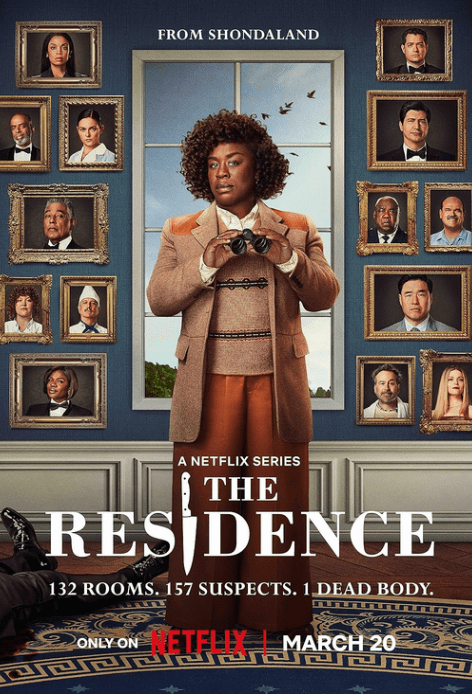
The Residence
I’ll start this review on the negatives so I can end on a high. In its entirety, there were parts of The Residence that were tedious. Mostly, the plot takes place over one night but there were constant breaks in-between that cut to a senate hearing. At times, the dramatic or comedic effect worked, but I felt this was only true when used sparingly. The continual break-aways to the court room became annoying quite quickly. Senator Bix certainly shouted a lot. As a character, she was evidently a plot device to repeat what the audience already knew, as well as to focus on the corruption in politics. The latter aspect, I liked, but the repetition of information was what made these scenes tedious.
Thankfully, these moments were minor but the feeling of this show being drawn out was felt primarily during the finale. It was a longer episode than usual, though it didn’t need to be. The explanation was prolonged to the point of exhaustion – an exciting reveal became boring very quickly. Since this is the climax of the show, this did lower the tone for me. The audience was already aware of most of the information, same as what was recapped in the court hearing, so to hear it all over again, as well as the additional explanation was unnecessary. Sometimes, in whodunnits, you can overexplain. This definitely happened here. The finale felt the need to parse out every single detail and when the whole series is dedicated to one crime, that’s a lot of information. The writers needed to trust in the audience’s intelligence a little more and fast-forward to the ultimate reveal.
As for the positives, I loved the way this show was filmed. The back and forth added to the bustle of the White House and the urgency of the case. It also added to the humour excellently. Other visual aspects were also well done, such as the set and costumes. It was a visual treat in many ways, with distinct rooms that added to the vibe of a true murder mystery. Overall, I did like the humour of this show. It made me laugh. For some, it may have been repetitive but the constant joke of Cordelia birdwatching got me every time. Even when you expected it, it was so funny to see her outside and everyone is stood watching her at the window.
The acting was excellent. Uzo Adubo truly carried this show – she fully leant into the eccentric energy that it wanted and needed. I, too, can understand the impulse to make everything about my special interest whilst carrying a book on that exact interest in my bag at all times. In fact, the use of birdwatching was an interesting character quirk whilst providing a useful transition into Cordelia’s insights and explanations.
Most importantly, as an entry into the genre, it’s easy to envision Cordelia sharing a space with some of the most famous detectives on page and screen – Poirot, Marple, Columbo, Blanc, etc. She has her own style of investigation, dress, and personality that makes her as distinct as the rest. This is what you want when introducing a new ‘world-famous’ detective and I didn’t question for a moment that she deserved to be there.
As a whole, the cast was incredible, especially Giancarlo Esposito. He must be the most sympathetic murder victim I’ve ever seen. I didn’t realise Andre Braugher was supposed to be in this show – the homage to him at the end was unexpected and lovely. It would have been great to have seen him in this; I have no doubt he would have aced it. At this point, however, I can’t imagine anyone other than Esposito as A.B. Wynter. He did such a great job.
Moreover, I enjoyed the show taking place over one night; I wish it had stayed that way. To have it solved not just in one night but in one setting would have worked better in my opinion. It didn’t bother me that it remained there, so long as there were continuing twists and turns. The break later in the show was disorienting to me, since we had spent multiple episodes at the White House. I feel like there were ways to have caught the killer without returning to the crime scene later. So, this is a plus and a negative. I liked the setting to the point that I wish they’d stayed there and seen it through.
Altogether, there was a lot I loved about this show and I would watch the second season, but I do feel there were parts of it that didn’t suit me, such as the continual courtroom interruptions, the sudden shift in setting, and the lengthy final explanation. It would have strengthened the show to have cut these. However, there was also a lot that I liked about it. I wouldn’t say it’s as excellent and brilliant as people are making it out to be, but I would definitely recommend it, as well as watch it again in the future. It was a fun watch and I look forward to seeing what they do with this show next season.
My Favourites
Easily, my favourite books this month were, in no particular order:
- If Not, Winter, Sappho (trans. Anne Carson).
- A Room of One’s Own, Virginia Woolf.
- I Who Have Never Known Men, Jacqueline Harpman.
Women have reigned supreme this month and for good reason. There were so many excellent texts but these were the stand outs for me. I just loved them! They may be new favourites.
Currently, I’m reading Le Morte d’Arthur and Lud-in-the-Mist, both of which are part of the reading challenge. I’m reading the tales a handful at a time, as I’m unused to reading medieval text continuously (it’s over five hundred pages long). In the meantime, I’m reading Lud in its entirety. I’m enjoying both but, so far, I love Lud-in-the-Mist.
I was a little disappointed not to watch any of the films, as I did want to continue with the second half of Dancer in the Dark, as well as The Fifth Element. However, it gives me an excuse to have a bit of a film month. I’ve already started May with a couple of films, so I’m hoping to catch up on my watchlist soon.
Altogether, April was definitely a month of being pushed out of my comfort zone, exploring genres I haven’t read before or in years. I don’t know if I’d have done this if it wasn’t for the reading challenge. I’ve discovered how much I enjoy these genres and literary periods, much more than I thought I would. So, that has been a wonderful surprise! I also think it spurred a month of avid reading. It was completely unexpected but nice, nonetheless. One thing I’ll say is if anyone knows any good modern retellings or fictional extensions of The Iliad or Oedipus Rex, I would be more than happy to read them, so feel free to drop any recommendations in the comments or in a message! I’m going through an Ancient Greek withdrawal right now.
 T.M. Hanson
Leave a comment