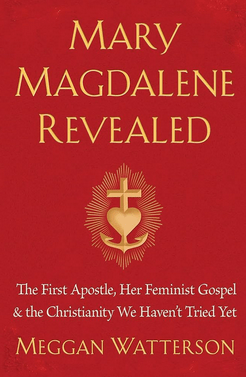
Name & Author: Mary Magdalene Revealed: The First Apostle, Her Feminist Gospel, & the Christianity We Haven’t Tried Yet by Meggan Watterson.
Genre: Non-Fiction, Religious Commentary, Social Commentary, Religious Non-Fiction, Spiritual Non-Fiction.
Diversity Tags: Christianity, Feminist Theology, Gnosticism.
Rating: 4.5/5.
Summary
The Gospel of Mary Magdalene reveals a very different love story from the one we’ve come to refer to as Christianity. Harvard-trained theologian Meggan Watterson leads us verse by verse through Mary’s gospel to illuminate the powerful teachings it contains.
Review
I want to start by saying that I absolutely love this book! I read it in the summer of last year and, feeling I needed to digest it some more, came back to read it again very recently. I actually bought this completely on a whim and I’m so glad I did!
Mary Magdalene Revealed is about Watterson’s own interpretations and lived experience of the Gospel of Mary. Despite it being her professional and personal analysis in regards to the passages, there is also some historical, religious, and biblical context provided. Part memoir, part self-help, Watterson introduces the Gospel of Mary and its main messages in a way that is understandable to the modern audience. Watterson divides the book into Seven Powers of the Ego, revealing how to overcome them through her own personal experiences and interpretations. It’s a practical format, and I personally liked having them split this way, as we go on a journey through Mary’s teachings. Despite the fact that they intertwine and you can go back and forth between them, having them outlined in a linear way made it easier to understand.
However, some sections had more in than others. Plus, some of the ways that Watterson related her personal experiences to these Seven Powers of the Ego were a little confusing at times, as I wasn’t really sure how they were all relevant or fit that particular topic. This could be my own ignorance or it could have just been Watterson related to some more than others. Yet, as an introductory book into Mary’s Gospel, I do think some people who read this won’t necessarily be well-versed in religion or spirituality, so the book would have benefitted from being clearer in terms of why these topics or personal stories related, as not everyone will have that level of insight.
Moreover, as Watterson is a qualified theologian, I was expecting a little more analysis in regards to Mary’s Gospel but at the same time, I wasn’t bothered by what was provided. I very much saw this as an introduction to the Gospel of Mary, since I’d never heard of it before, and it did its job in encouraging me to want to read more.
Watterson has a way of inspiring the reader, revealing a Christianity that allows the reader to feel seen and valued, regardless of personal identity, and introduces a topic in a way that is compassionate and gentle. I also enjoyed that she asks very real and honest questions. By real, I mean that she asks the simple question of- if Christ was a real man, he surely would have fallen in love or had sex? And I think bringing the realism and the mundane into the spiritual is something I personally prefer, as I believe the two are inseparable. For some, they may find this vulgar but I don’t personally take this view, and find it easier to connect to these figures as human beings compared to mythical or divine creatures that we can never relate to, due to them being so ‘above’ us in nature.
Coming from a minority perspective, I appreciated the view Watterson took towards Christianity. Having been raised Roman Catholic- though no longer practising- I completely understand what Watterson meant when she wrote about feeling outside of her religion, due to the way Christianity omits the feminine, how the religion only acknowledges the feminine when it’s seen as virginal and pure. Reading this book, I felt like I was being taken back to my childhood, to my experiences in the Church, and wholeheartedly agreeing with the way you can feel a discord between the patriarchal God and the God we may have felt within our heart and mind growing up, and how we can’t always reconcile the two.
Altogether, Watterson’s love for Mary Magdalene, as well as her love for women, is very much felt. I enjoyed being introduced to the world of Christian feminism, as well as the Christian stories and figures that were unknown to me my whole life. Although I don’t practice any religion, I am spiritual and being introduced to a more inclusive, women-led, and peaceful approach to Christianity, as well as one that is person-centred, is very new and exciting for me.
Concluding Remarks
Overall, I was incredibly inspired by the discovery of this gospel, as well as its overarching message, and I would definitely go away and read more surrounding the topic and life of Mary Magdalene, which is handy, as there is a list of further reading at the back of the book. However, if you are someone who is looking for the whole gospel or for a deeper theological analysis or accompanying guide, this won’t be for you. This book never claims to be that, however, so I don’t think it would be fair to hold it to such standards but be aware that this is an introduction piece, as well as being part memoir/a personal perspective on what Mary Magdalene means to the author. I personally like hearing about other people’s experiences and perspective, so this wasn’t an issue for me. Instead, I found the book enjoyable and felt like I could personally relate to some of her struggles and joys.
Certainly, this book delivered in my opinion. Watterson didn’t promise an in-depth analysis nor a whole recantation but instead, promoted the main ideals and facts of Mary’s life, as well as how to connect to that from a personal perspective. If you’re looking for a book celebrating Mary and her legacy for women and Christianity, how her teachings and her position in religion changes our perspective on Christianity altogether, and how the author has integrated these teachings in a very personal way, then this is the book for you! It’s a nice little introduction to Mary Magdalene and to feminist theology, and I certainly recommend it. It’s very joyful, uplifting, and honest.
Would I recommend?
100%, yes!
 T.M. Hanson
Leave a comment