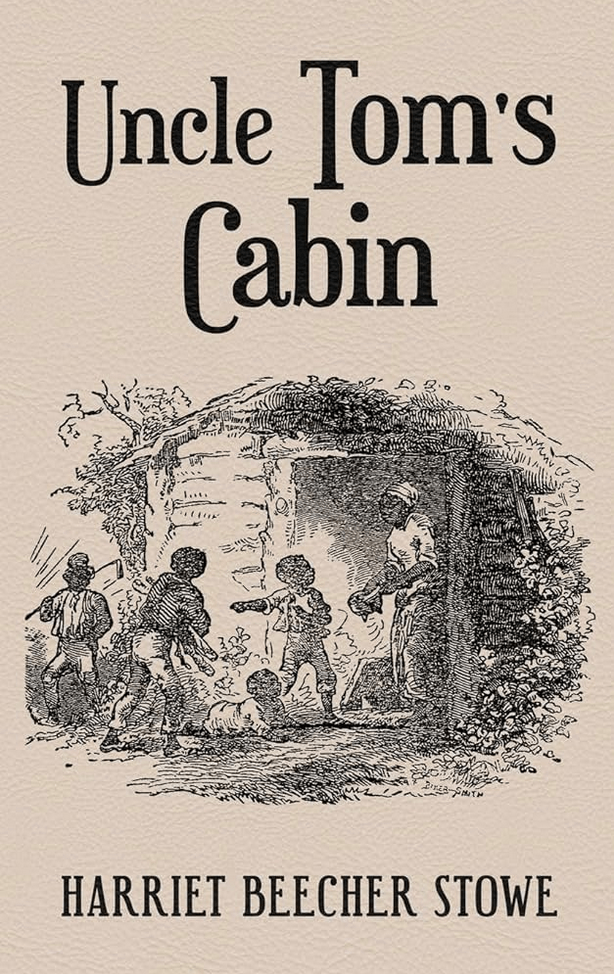
Name & Author: Uncle Tom’s Cabin (or Life Among the Lowly) by Harriet Beecher Stowe.
Genre: Philosophical, Adventure, Tragedy, Political/Social Commentary, Period Novel, American Literature, Serialised Novel.
Diversity Tags: Black Characters, Women Characters, Religion and Spirituality (Christianity).
Rating: 3.5/5.
Summary
Uncle Tom’s Cabin follows the life of a slave named Tom after he is auctioned to save his owner’s estate from debt. Passing through kindly households to the depraved plantations of the American South, the evils of slavery are revealed and explored. Parallel to Tom’s story is the tale of Eliza and George, a married couple, who escape from their respective owners to find freedom in Canada so that they may escape separation- from each other and from their son- and own a home of their own.
Triggers
There are a variety of triggers in Uncle Tom’s Cabin, including racial discrimination and abuse, misogyny and abuse against women, child abuse and insinuated molestation, insinuated rape, the overall subject of slavery, substance abuse, suicide, murder, torture, general psychological distress, mental illness, and death.
Review
I had a divided opinion on Uncle Tom’s Cabin overall, as I felt it was a novel before its time but also a novel of its time, having been published in 1852. For readers who are unfamiliar with this piece, it’s a novel written by the abolitionist Stowe, who wished to reveal the legislative and moral evils of slavery and which incited and contributed to the discussion around the abolition of slavery in America.
It was ahead of its time in terms of its abolitionist and spiritual voice but the narrative and the commentary still fall into the trappings of the age as Stowe, a white woman, was writing from an outside perspective, meaning she was not fully able to encapsulate the voice of black slaves without somewhat falling into the notion that black and white people are fundamentally different and that slaves, even if free, were somewhat primitive in nature. There are acknowledgements on Stowe’s behalf as to why this is, such as a lack of formal education and the overall prevention of slaves from obtaining free will within a corrupt and demoralising system, yet I feel, as progressive as Stowe was for the time, she was not able to fully encapsulate the multi-faceted nature of black slaves as human beings without falling into some caricatures.
Nevertheless, this book was created as a challenge to white Americans to realise their lack of compassion, their condescension, and even their disgust for black Americans, as well as how immoral this stance is against another human being, and for this, I at least appreciate the effort made to tackle this subject, especially when Stowe’s opinion was not particularly a popular or accepted one. Plus, to say this opinion will do her no harm as a white educated woman was not particularly true, as some of her personal practices and those mentioned in the book were illegal during this time, such as aiding and housing runaway slaves, and some of this was shared at her own risk.
Fundamentally, Stowe persists in the idea that freedom can be earned through moral righteousness without any help from revolutionary or social action/change. This, for me, was the difficulty of the novel. I don’t struggle to connect to Stowe’s spiritual views and for the most part, I appreciate them. I deeply admire and agree with the ideas of non-violence, interbeing, and how we must lean into our collective responsibility towards all human beings, but I also personally believe in active resistance and change, if there is no other choice left.
As this is what the novel rests upon- the idea of pacifism to solve all issues, especially pacifism from those who are being actively and institutionally enslaved- I can’t fully sit comfortable in its message. Yet, it’s also a story from a white woman speaking to her social class about their moral character, as well as their passive compliance within an abusive system, rather than a story necessarily for slaves living at the time. So, this is also something to be taken into consideration when deciding if this novel is for you. Personally, I felt it had its good points and its bad, and left a lot of space for contemplation and discussion. I found it hard to settle fully on whether I liked or disliked it, but found I did lean towards the latter.
Characters
Altogether, there are a mixture of perspectives in regards to race, age, gender, class, and religion. It was ahead of its time, I believe, in providing a slightly more complex portrayal of black characters and lives compared to the portrayals common in literature at the time, though I do still believe caricatures are very much present. Even some of the white characters suffer from a lack of development or are used simply as a narrative device. For the time, some of the black characters are a lot more multi-faceted than the reader would have been used to, which I do appreciate, but for a modern reader, it’s easy to see that this representation hasn’t aged well.
I actually found it easier, however, to emotionally connect to the black characters than to the white, as most of the characters lacked any depth or were deeply unlikable. Nearly all of the white characters I found to be quite uninteresting and generally quite hypocritical, due to their continuing involvement with the slave trade. I know this was the aim of Stowe- in terms of commenting on men and women’s engagement, even passively, with a corrupt system- so, for that, I do give her credit, but this does make them hard to connect to. Even the ones that are meant to be ‘nicer’ can be quite condescending or self-righteous and it was hard to connect or sympathise with them, despite other redeeming qualities. There is also a hint of the ‘white saviour’ in this book, particularly with little Eva, which I never appreciate and personally disliked, so this did lower the tone for me.
The Ending
I didn’t appreciate the ending. I know the ending was presented by Stowe as the worst-case scenario, which is that the oppressive class wait until it’s too late to do what’s right, so I can also appreciate that the ending, in some ways, had to happen but it still felt frustrating to read. It was hard to watch the suffering of an oppressed group of people and hope that the ruling class cared enough to change their ways, which was shown as the only and ultimate way out of this suffering.
I appreciate some of the points being made by Stowe- that a resistance to change and the silent compliance and acceptance of social ills by the oppressor leads to misery, injustice, and death of the oppressed. However, from the perspective of an oppressed class/group, I also don’t believe in waiting for other people to care about your existence or your wellbeing to enact social change. I believe some of us would be waiting a long time, if that were the case. So, I don’t entirely agree with what the option was, which is to wait for divine intervention or for people who are forcefully oppressing others to suddenly gain a conscience. This was particularly hard to stomach and led to a lot of dissatisfaction on my part, hence why I was generally unhappy with the end. Yet, despite it all, I do objectively appreciate the spiritual lessons that Stowe was trying to instil, though it got lost amidst the real-life loss, despair, and politics of the time and what that actually meant for those who were enslaved.
Would I recommend?
It depends!
Overall, I didn’t dislike the book. I didn’t always agree with its concluding remarks but Stowe was clearly passionate about the injustices endured by slaves and the right for anyone, regardless of race, to obtain freedom. She deliberately and thoughtfully revealed the abuse in both kind and intolerant households, revealing that slavery is, at the end of the day, still slavery, even if masters were kind and generous.
I feel Uncle Tom’s Cabin has its place in time, allowing a modern reader to see into the discussions and arguments that were taking place during the abolitionist movement in the US, as well as some of the real-life happenings of slaves and slave-owners in America. It has its faults and its limitations, and it’s up to the reader to decide if it’s worth the read, but I think it offers a perspective for the age in which it was written and, from that point of view, is an interesting and insightful book. However, it is also an unsettling and upsetting read, and I can see why modern readers may not want to bother with the book, for some of the caricatures, beliefs, and traumas that it includes. This is definitely something to take into consideration, as to whether you can accept the book as it is. As a historical and political read, I found it interesting but from any other perspective, I personally wouldn’t read it again or rate it highly. I felt once was enough.
 T.M. Hanson
Leave a comment